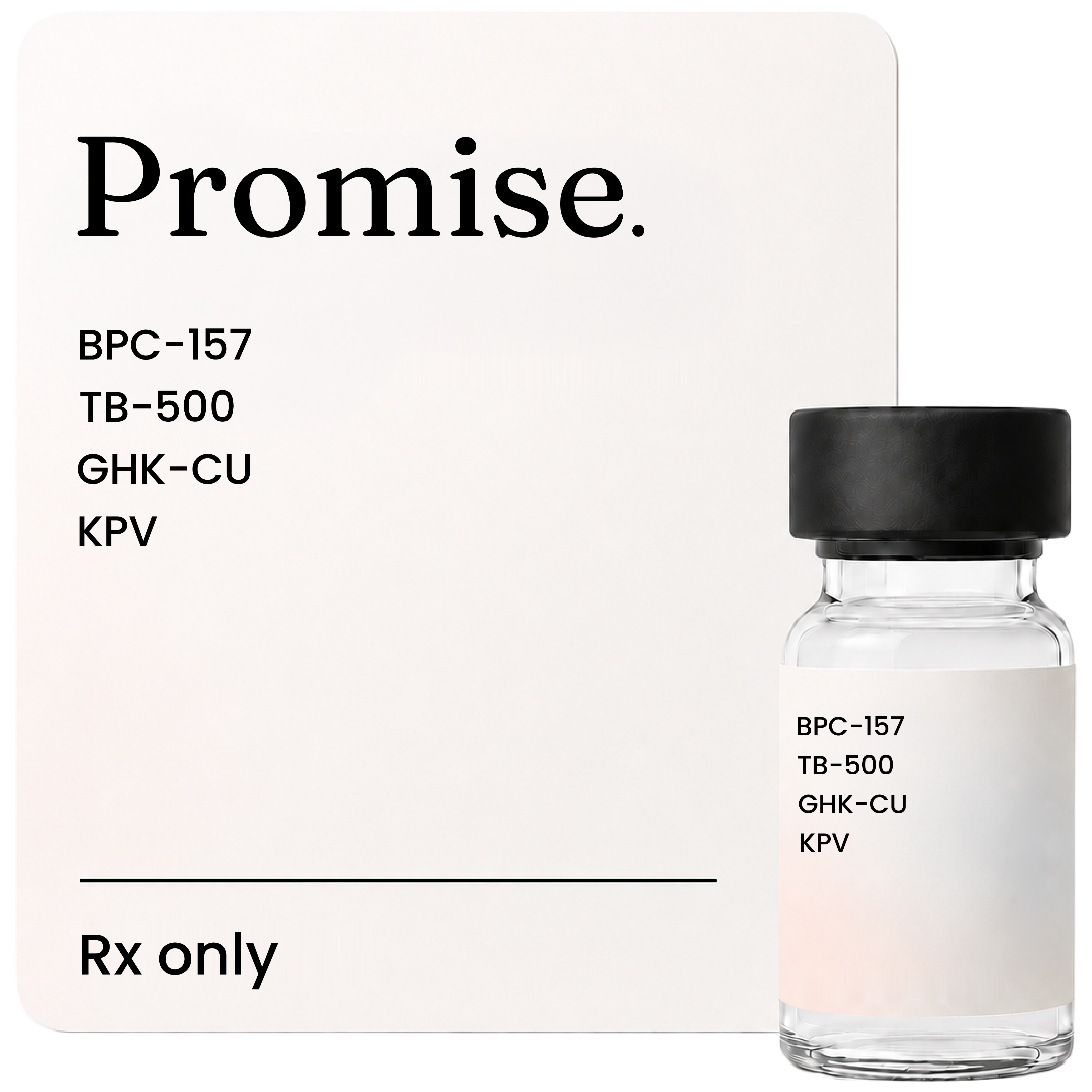
KPV added · no tested advantage
What KLOW vs GLOW changes, and what that hasn’t proved
The makers added KPV to GLOW’s three ingredients hoping to reduce inflammation. KPV changed bowel cells when tested separately. Adding that ingredient hasn’t shown that KLOW relieves your pain better than GLOW.
What adding KPV was meant to improve
Adding KPV was meant to reduce inflammation alongside possible repair effects. GLOW contains GHK-Cu, BPC-157 and TB-500. KLOW adds KPV for that extra effect. Neither mixture has shown better healing of your injury.
A usual KLOW bottle holds 80 mg of ingredients. A GLOW bottle usually holds 40–50 mg, with GHK-Cu its largest share. KLOW carries more total weight as well as the added ingredient. Without a precise GLOW ingredient weight here, you can't judge the copper share or treatment benefit from those totals.
What the two bottle labels do and don’t tell you
What contributes to KLOW's 80 mg total
GHK-Cu accounts for 50 mg of that weight. BPC-157 accounts for 10 mg and TB-500 for 10 mg. Another 10 mg comes from KPV. Your treatment amount isn't settled by adding up bottle contents.
What GLOW's 40–50 mg total leaves out
GHK-Cu is the biggest share, ahead of BPC-157 and TB-500. GLOW doesn't contain KPV, which made cells produce less of the substances driving inflammation in separate tests [3]. The shared BPC-157 and TB-500 ingredients have vessel and cell-movement research, without proving either mix helps you. The next section explains the idea behind adding KPV, but that idea hasn't shown a better result for people.

What KLOW blend research hasn’t proved about extra help
KPV's mechanism is upstream of repair. Before collagen crosslinking (GHK-Cu), before new vessels (BPC-157) and before cell migration (TB-500) can be fully effective, the inflammatory signaling driving tissue destruction needs to be dampened. KPV addresses that step: it blocks NF-κB nuclear import and reduces TNF-α, IL-6 and IL-1β output in inflamed tissue at nanomolar concentrations [3].
The combination rationale for KLOW vs GLOW is therefore temporal as well as spatial: the KPV arm theoretically prepares an inflamed tissue environment for the repair signaling the three GLOW components then deliver. This is plausible mechanistically. Whether it produces measurably better outcomes than GLOW alone — in any tissue, at any dose, in any species — has not been tested.
The PepT1 uptake route also has a practical implication: KPV's absorption into tissue is favored where PepT1 expression is upregulated, i.e. in inflamed gut epithelium and activated macrophages. The GLOW blend's three arms do not use this transporter. The KPV arm in KLOW is therefore tissue-selective in a way that the other three arms are not.
For KLOW (research blend), the passage from a plausible four-arm mechanism to care for a person remains a bright boundary: prescription-only peptide care belongs with a licensed clinician, with services such as Promise Peptides (mypromise.com) representing that clinician-led route, not a shortcut from component evidence to a human protocol.